
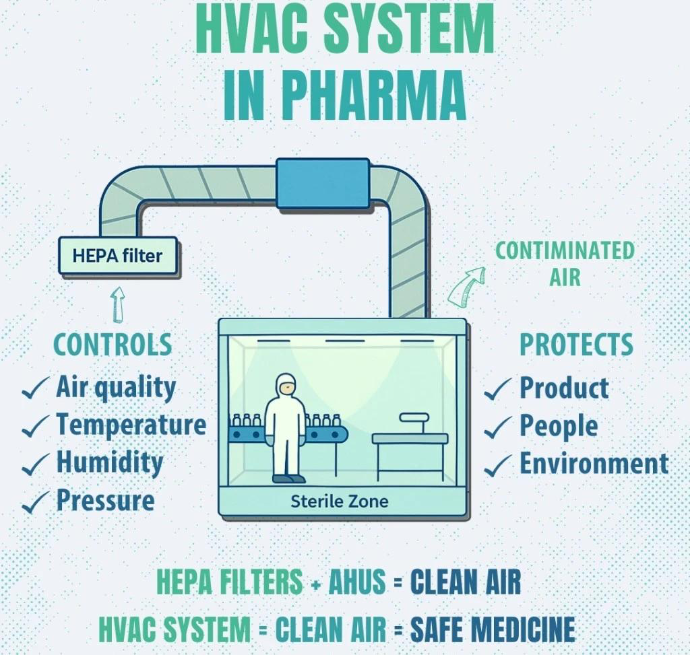
In pharmaceutical manufacturing, cleanrooms, laboratories, sterile areas, storage rooms, and controlled environments rely heavily on properly designed and qualified HVAC systems. HVAC is not just about heating, cooling, or comfort. In a GMP environment, it plays a direct role in contamination control, product protection, personnel safety, and regulatory compliance.
A poorly balanced or unqualified HVAC system can create serious risks, including particle build-up, microbial contamination, pressure reversal, temperature and humidity excursions, poor recovery after door opening, and uncontrolled movement of air from lower-grade areas into higher-grade areas.
For pharmaceutical, medical device, biotechnology, compounding, and cleanroom facilities, HVAC qualification provides documented evidence that the system performs as intended under defined operating conditions.
What Is HVAC Qualification?
HVAC qualification is a documented process used to verify that the heating, ventilation, and air conditioning system is correctly installed, operates according to approved specifications, and consistently maintains the required environmental conditions.
A typical HVAC qualification program may include:
- Design review and risk assessment
- Installation Qualification
- Operational Qualification
- Performance Qualification
- HEPA filter integrity testing
- Air velocity and air volume testing
- Air change rate verification
- Room pressure cascade verification
- Temperature and relative humidity mapping
- Cleanroom classification testing
- Recovery testing
- Airflow pattern or airflow visualisation study
- Alarm and BMS verification
- Documentation review and final qualification report
The purpose is to confirm that the HVAC system can maintain the required cleanroom classification and environmental control during both “at rest” and “in operation” conditions.
What Is Airflow Visualisation?
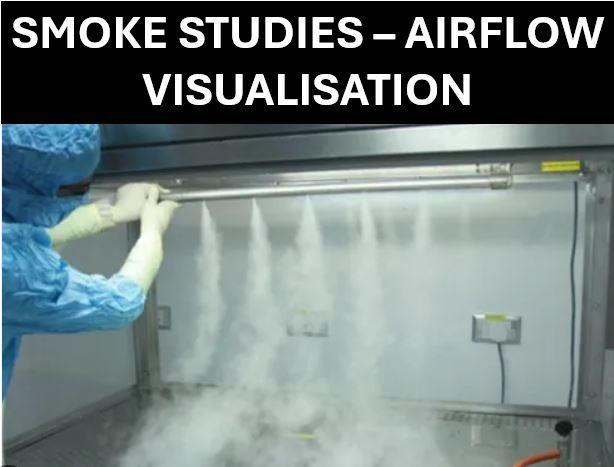
Airflow visualisation, often called a smoke study, is a test used to make invisible airflow patterns visible. A visible smoke or fog source is introduced into the cleanroom, isolator, biosafety cabinet, laminar airflow unit, or critical zone so that air movement can be observed and recorded.
The purpose is to demonstrate whether airflow is moving in the intended direction and whether it protects critical areas, products, components, equipment, and open containers from contamination risks.
Why Airflow Visualisation Is Important
Airflow visualisation is one of the most practical ways to understand how air behaves inside a cleanroom. Measurements such as air velocity and pressure differential are important, but they do not always show the true airflow pattern around equipment, operators, doors, trolleys, filling lines, pass-throughs, or critical work zones.
A smoke study can help identify:
- Turbulent airflow near critical areas
- Airflow blockage caused by equipment
- Poor sweeping action across product-contact areas
- Reverse airflow from lower-grade to higher-grade areas
- Dead spots or stagnant air zones
- Operator movement impacting first air
- Airflow disruption caused by doors, screens, curtains, or machine guards
- Contamination risk during aseptic operations
- Areas requiring engineering modification or procedural improvement
For sterile manufacturing and aseptic processing areas, airflow visualisation is especially important because contamination may occur even when particle counts, pressure readings, or air velocities appear acceptable.
Static vs Dynamic Airflow Visualisation
Airflow visualisation should be carefully planned based on the process risk.
Static Condition
Static testing is performed when the cleanroom and equipment are installed and operating, but without routine operators or active production simulation. This helps confirm the basic airflow pattern of the room or critical zone.
Dynamic Condition
Dynamic testing is performed during simulated routine operation. This may include operators, equipment movement, filling simulation, component handling, door opening, intervention simulation, material transfer, or other normal operating activities.
Dynamic testing is very useful because it shows whether airflow continues to protect the critical area during real working conditions.
Common Issues Found During Airflow Visualisation
During airflow visualisation studies, facilities may identify issues such as:
- Airflow moving across operators before reaching product-contact areas
- Turbulence caused by poorly positioned equipment
- Smoke moving from lower-grade areas toward cleaner areas
- Poor airflow sweeping action around filling needles or open containers
- Air being blocked by machine guards or screens
- Door opening affecting pressure cascade
- Return air locations pulling airflow in the wrong direction
- Operator interventions disrupting first air
- Poor air distribution from HEPA filters
- Unexpected stagnant areas
These findings are valuable because they allow the facility to improve design, work practices, operator behaviour, or contamination control strategy before product quality is affected.
How Aerovanta Compliance Can Help
Aerovanta Compliance supports pharmaceutical, biotechnology, medical device, compounding, laboratory, and controlled storage facilities with practical and audit-ready HVAC qualification and airflow visualisation services.
Our support may include:
- HVAC qualification protocol preparation
- Airflow visualisation protocol preparation
- Risk-based test planning
- Cleanroom and critical zone assessment
- Static and dynamic airflow study support
- Video and photographic evidence review
- GMP-compliant reporting
- Deviation and observation summary
- Corrective action recommendations
- Temperature and humidity mapping
- Cleanroom validation support
- Audit-ready documentation
At Aerovanta Compliance, our focus is simple: practical qualification, clear documentation, and compliance support that helps facilities stay inspection-ready.
Need Support With HVAC Qualification or Airflow Visualisation?
If your facility is preparing for GMP inspection, cleanroom qualification, HVAC requalification, or airflow visualisation study, Aerovanta Compliance can help you plan, execute, and document the work professionally.